

The Infamous Farewell: Inside GG Allin’s Notorious Funeral
In the annals of rock and roll history, there are few figures as polarising and provocative as GG Allin. Known for his confrontational performances, explicit lyrics, and shocking antics both on and off stage, Allin was a figure who defied convention at every turn. So, it’s perhaps fitting that his funeral would be as controversial and memorable as his life.
Who Was GG Allin?
To understand why his funeral attracted so much attention, it’s important to understand who GG Allin was. Born Jesus Christ Allin in New Hampshire in 1956, he would become one of the most notorious figures in the history of punk rock.
Throughout the 1980s and early 1990s, Allin built a reputation that went far beyond his music. His live performances were infamous for their unpredictability, often descending into violence, self-harm, and confrontations with audience members. While many musicians cultivated rebellious personas, Allin seemed determined to push every boundary he encountered.
His behaviour earned him a devoted cult following as well as widespread condemnation. Supporters viewed him as the ultimate anti-establishment artist, while critics saw him as little more than a dangerous provocateur. Either way, he succeeded in making himself impossible to ignore.
By the time of his death in 1993, GG Allin had become less of a conventional musician and more of a countercultural legend. His reputation for chaos ensured that even in death, he would continue to attract fascination.
The Death of GG Allin
On 28th June 1993, fans and curiosity-seekers gathered at the St. Rose Cemetery in Littleton, New Hampshire, to bid farewell to the punk rock icon. But this was no ordinary funeral. True to his reputation, Allin had left behind explicit instructions for his final send-off. He wanted his body to be unembalmed, and he desired an open casket ceremony so that mourners could see him in his natural state (bloody and whiffy), just as he had lived.
The Final Days Before His Death
The events leading up to GG Allin’s death were as chaotic as much of his life. On 27th June 1993, he performed what would unknowingly become his final concert at the Gas Station, a small club in New York City’s East Village.
The show quickly descended into disorder. After performing only a handful of songs, Allin became involved in confrontations with members of the audience, and the venue eventually shut the performance down. Unfazed, he and a crowd of followers spilled out into the streets, where the impromptu spectacle continued for hours.
Later that evening, Allin attended a party in Manhattan. It was there that he suffered a fatal heroin overdose at the age of 36. Despite years of dangerous behaviour and repeated predictions that he would die young, the news still shocked many within the underground punk scene.
Photographs taken shortly after his death have since become almost as infamous as his performances. In them, Allin’s body can be seen lying on a bed, surrounded by friends and acquaintances who appeared to be treating the scene more like a gathering than a tragedy. The images only added to the mythology surrounding his final hours and reinforced his reputation as one of music’s most extreme figures.
A Funeral Unlike Any Other and the Infamous Souvenir Grab
Allin’s funeral was a spectacle unlike any other. As his body lay in an open casket, dressed in a soiled jockstrap and a black leather jacket, attendees were greeted with the unmistakable scent of decay. Some were repulsed, while others were fascinated by the sight before them. It was a macabre tableau that perfectly encapsulated Allin’s ethos of shock and defiance.
But the most infamous moment of the funeral was yet to come. True to his promise of a no-holds-barred farewell, Allin’s brother, Merle, announced to the crowd that they were welcome to take souvenirs from the casket. And take they did. Mourners descended upon Allin’s body, grabbing whatever they could get their hands on; it was a chaotic scene that would horrify and disgust many.
To some, Allin’s funeral may have seemed like nothing more than a grotesque publicity stunt. But to others, it was a fitting end to a life lived on the fringes of society. Allin himself had often spoken of his desire to shock and provoke, and in death, he achieved just that.
The Funeral Photographs
Much of the enduring fascination with GG Allin’s funeral stems from a series of photographs taken during the service. Unlike traditional funeral images, these pictures captured an event that seemed to blur the line between memorial and performance art.
The photographs show Allin’s body displayed in an open casket while mourners pose for pictures, make gestures towards the camera, and interact with the corpse in ways that many would find deeply unsettling. The images quickly circulated through punk fanzines and underground publications before finding a much larger audience online in the years that followed.
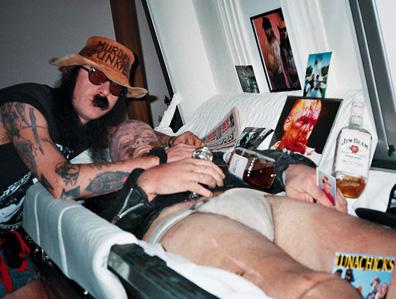
Archival photograph from GG Allin’s funeral (1993), original photographer unknown.
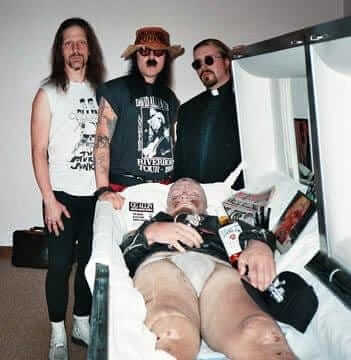
Archival photograph from GG Allin’s funeral (1993), original photographer unknown.
For many people, these photographs provided their first introduction to GG Allin. Even those unfamiliar with his music were often shocked by the bizarre scenes they depicted. Decades later, the images continue to appear on social media, internet forums, and websites dedicated to unusual moments in music history.
Part of their enduring appeal lies in how perfectly they encapsulate Allin’s reputation. The photographs seem less like a conventional funeral and more like the final chapter in a life spent deliberately provoking outrage.
GG Allin’s Lasting Legacy
In the years since his death, Allin’s legacy has only grown more controversial. Some see him as a misunderstood artist whose confrontational persona was a critique of societal norms. Others view him as little more than a shock jock, whose antics were more about garnering attention than making any meaningful statement.
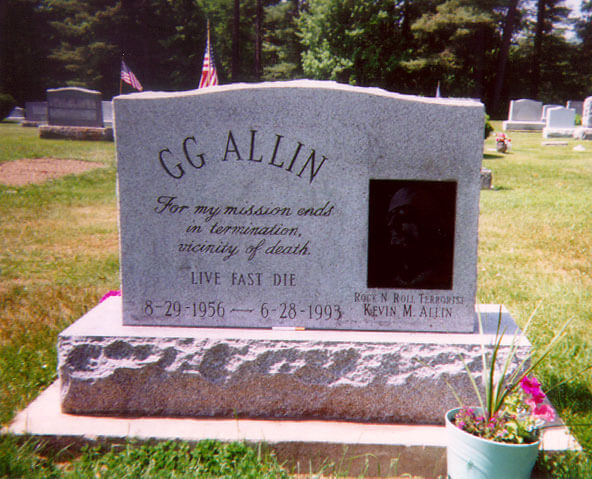
GG Allin Grave Site. Photo credit: Sweed666.
But regardless of your opinion of GG Allin, there’s no denying the impact he had on the world of punk rock and beyond. His willingness to push boundaries and defy convention left an indelible mark on the music industry, inspiring countless artists to embrace their own rebellious spirit.
Conclusion: A Farewell True to the Man
In the end, GG Allin’s funeral was a fitting conclusion to a life lived on the edge. It was a raw, unfiltered expression of the man himself, shocking and controversial to the very end. Love him or hate him, there’s no denying that GG Allin left an unforgettable legacy – one that continues to fascinate and provoke to this day.
Frequently Asked Questions About GG Allin’s Funeral
How did GG Allin die?
GG Allin died from a heroin overdose on 28 June 1993 at the age of 36.
Where is GG Allin buried?
He is buried at St. Rose Cemetery in Littleton, New Hampshire.
Was GG Allin really buried wearing a jockstrap?
According to numerous accounts from those present, Allin was buried wearing a leather jacket and jockstrap, reflecting his unconventional lifestyle and wishes.
Why did people take items from the coffin?
Some attendees reportedly treated the funeral as a final celebration of Allin’s life and persona, leading to behaviour that many observers considered shocking or disrespectful.
Can you visit GG Allin’s grave today?
Yes, but be aware that his gravestone is no longer at his burial site since 2010 (it can now be found exhibited in the Museum of Death in Hollywood, CA). Even so, his grave remains a destination for fans and curiosity-seekers, although visitors are expected to respect the cemetery and surrounding area.
Please note – photographs from GG Allin’s funeral, St. Rose Cemetery (1993) have been widely circulated in punk archival collections online for years. Original photographer is unknown, but if you are the owner of the image, please contact me, and I will either credit you in the article or remove the image immediately. Thank you.
Photo Credit: GG Allin Grave Site by Sweed 666.